

With inflation trending up again, the Federal Reserve is losing patience
- 11.13.26
- Economy & Policy
- Commentary
Raymond James Chief Economist Eugenio J. Alemán discusses current economic conditions.
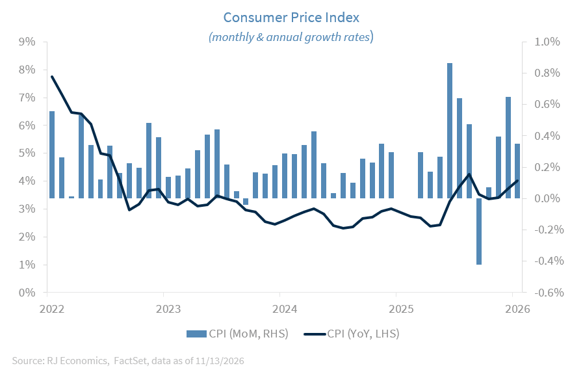
October's inflation report surprised to the upside, with consumer prices increasing more than expected and pushing the year-over-year rate to roughly 4.0%, although that estimate remains somewhat uncertain due to last year's government shutdown.
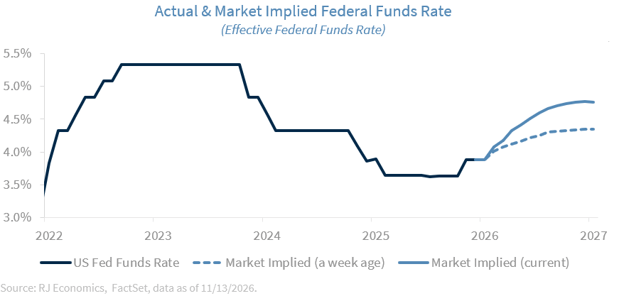
The debate has quickly shifted from whether the Federal Reserve (Fed) will raise rates in December to whether policymakers may opt for a 50 basis-point increase rather than the 25 basis-point move currently embedded in both market expectations and the Fed's previous dot plot projections. That discussion began even before the Consumer Price Index (CPI) release when Federal Reserve Governor Christopher J. Waller suggested that a larger increase might be appropriate. Others contend that even if the Fed ultimately raises rates by only 25 basis points in December, officials could signal a more aggressive policy path for 2027 than they projected in September.
Betting markets continue to favor a 25 basis-point increase in December but are also pricing in three more rate hikes by the end of 2027, which would lift the federal funds rate to a range of 4.50% to 4.75%.
As we have argued for several months, the main problem facing monetary policymakers is that much of today's inflation pressure continues to originate on the supply side of the economy. Higher gasoline prices, for example, are not the result of excessive consumer demand, nor are higher agricultural transportation costs being driven by an agricultural bumper crop. This is not a traditional demand-driven inflationary cycle, and interest rate policy is therefore less effective at addressing the source of the problem. Furthermore, a small share of US households benefits from higher interest rates because they hold interest-bearing assets and are not dependent on borrowing to sustain spending. For these households, higher rates can support consumption rather than restrain it.
At the same time, wage growth, salary gains, and government transfer payments are no longer accelerating at the pace seen during the post-pandemic reopening. As a result, there is far less fuel available to sustain an inflationary process similar to the one experienced during the recovery period.
We understand the argument that the Fed must respond regardless of the source of inflation. However, if policymakers were willing to look through portions of the post-pandemic inflation surge, they should also be willing to avoid overreacting to supply-driven price pressures today. We recognize that this remains a minority view and that additional rate increases are likely. Nevertheless, if the Fed responds too aggressively to a single inflation report, it risks tightening policy more than necessary. History suggests that when monetary policy overshoots, something eventually breaks, increasing the probability of a recession.
Our forecast continues to call for inflation to moderate throughout 2027 under current interest rate conditions, assuming no additional supply shocks emerge. Reaching the Fed's 2.0% inflation target, however, is likely to be a gradual process that takes several years. The alternative path to a faster decline in inflation would likely require a recession significant enough to weaken demand meaningfully. We hope policymakers choose patience over unnecessary economic pain.
Bottom line
Inflation remains uncomfortably high, but the underlying drivers are still largely supply-related. While the Fed appears increasingly inclined to tighten further, the greater risk may be overreacting and unnecessarily increasing the odds of a recession.
Economic and market conditions are subject to change.
Opinions are those of Investment Strategy and not necessarily those of Raymond James and are subject to change without notice. The information has been obtained from sources considered to be reliable, but we do not guarantee that the foregoing material is accurate or complete. There is no assurance any of the trends mentioned will continue or forecasts will occur. Past performance may not be indicative of future results.
